How to Brief a Clothing Manufacturer: What You Need Before You Request a Quote
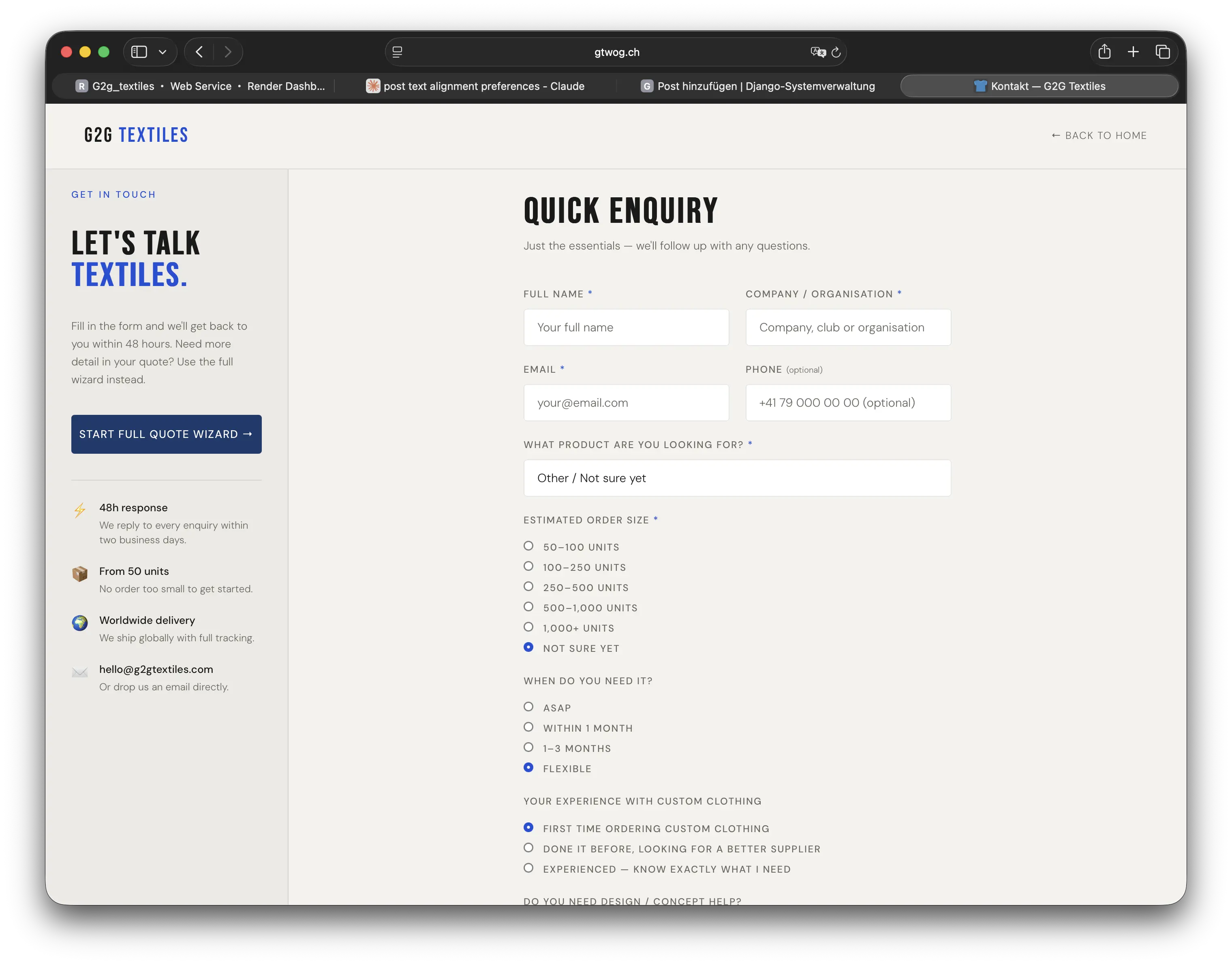
Most clothing manufacturers ask you to fill out a contact form and wait. You hear back three days later with a list of questions you didn't know you needed to answer. The quote you eventually receive doesn't quite match what you had in mind — and you're not sure why.
It doesn't have to work that way. If you go into the process with the right information prepared, briefing a manufacturer becomes straightforward — and you get accurate quotes faster, with fewer back-and-forths.
This guide covers exactly what you need to have ready before you reach out. Whether you're ordering for the first time or just want to make the process more efficient, it applies regardless of who you end up working with.
What You'll Need at a Glance
- Product type — what garment, what construction
- Quantity — total units and size breakdown
- Decoration method — print, embroidery, woven labels
- Fabric and quality level — weight, composition, feel
- Timeline — when you actually need the goods
- Budget range — even a rough one helps enormously
- Reference visuals — photos, sketches, brand files
1. Know What You're Actually Ordering
This sounds obvious, but "a hoodie" or "a polo shirt" isn't a brief — it's a starting point. Manufacturers need to know the construction, not just the category.
A few questions worth answering before you reach out:
- Is it a pullover or zip hoodie? Heavyweight or lightweight? Fleece-lined or French terry?
- For a polo: piqué or interlock? Short or long sleeve? With or without a placket pocket?
- For a tee: standard cut or boxy? Crew neck or v-neck? What weight do you want?
If you're not sure about some of these details yet, that's fine — a good manufacturer will help you work through them. But the more specific you can be upfront, the more accurate your quote will be.
2. Have a Quantity in Mind — Including Your Size Breakdown
Total unit count affects almost everything: price per piece, which production routes are viable, and whether certain factories will even take the order.
But the size breakdown matters just as much. An order of 100 pieces spread evenly across XS to XXL is very different from 100 pieces concentrated in M and L. Some decoration setups require minimum quantities per colour or per size run, so knowing your breakdown early avoids surprises later.
If you're genuinely unsure of quantities, give a range. "Somewhere between 80 and 150 pieces" is workable. "As many as possible" is not.
3. Understand the Decoration Methods You Want
How your logo or design gets applied to the garment is one of the biggest factors in both cost and final quality. The three most common methods are screen printing, embroidery and woven labels — and they're not interchangeable.
- Screen printing works best for bold, flat graphics — wordmarks, geometric logos, large chest prints. Cost-effective at volume.
- Embroidery adds texture and durability — ideal for chest logos, sleeve details, cap branding. Adds perceived quality but has a higher setup cost.
- Woven labels are finishing details — neck labels, hem labels, care instructions. They elevate the product feel significantly for relatively low cost.
You don't need to have made a final decision before briefing — but knowing roughly what you're after means the quote you receive will actually reflect what you want. For a real example of how combining decoration techniques works in practice, see our Bloc Magasin case study, where we combined screen printing, embroidery and woven labels on a single garment.
4. Think About Fabric and Quality Level
You don't need to know thread counts or fabric certifications off the top of your head. But it helps to have a sense of where you're positioning the product — and what kind of feel you're going for.
A useful shortcut: find a garment you already own that has roughly the weight and feel you're aiming for. Describe it, or bring it to the conversation. "Similar weight to a Champion reverse weave" or "softer and lighter than a typical Gildan tee" communicates more than a GSM number most of the time.
If sustainability matters to your brand or your customers — GOTS-certified cotton, recycled materials, European production — mention it early. It shapes which factories and fabrics are on the table.
5. Be Honest About Your Timeline
The single most common source of disappointment in garment production is a misunderstanding about lead times. From approved brief to delivered goods, custom garment production typically takes 8 to 16 weeks depending on the complexity, the decoration methods and the production origin.
If you need the goods by a specific date — an event, a product launch, a trade fair — say so immediately. It determines which production routes are actually viable for your order. Rushing production is expensive and sometimes simply not possible.
If your timeline is flexible, that's useful information too. It opens up options.
6. Have a Budget Range Ready
This is the part most people are reluctant to share upfront — but it's one of the most useful things a manufacturer can know.
Giving a budget range doesn't mean you're handing over your negotiating position. It means the person quoting your order can immediately tell you whether what you want is achievable within that range — or whether there are trade-offs worth discussing. A rough number like "we're thinking CHF 20–30 per piece landed" is genuinely useful context.
Without a budget range, you might receive a technically accurate quote for a specification that was never going to work for you. That wastes time on both sides.
7. Prepare Your Visual References
Even a rough sketch or a photo of a garment you like is more useful than a written description alone. If you have brand files — logo in vector format, brand colours in Pantone or HEX — have those ready too.
For decoration work, vector files (AI, EPS, SVG) are almost always required for accurate production. JPEG or PNG logos can work in some cases, but they may need to be redrawn — which adds time and sometimes cost.
If you don't have these files yet, that's fine. Just flag it early so it can be factored into the timeline.
Putting It Together
A solid brief doesn't need to be a formal document. It just needs to cover the basics: what you want, how many, how it should be decorated, what quality level you're aiming for, when you need it, and roughly what you're willing to spend.
With those seven things in place, most manufacturers — including us — can turn around an accurate, detailed quote quickly. Without them, the back-and-forth can stretch a simple quote process into two or three weeks of email chains.
How We Handle This at G2G
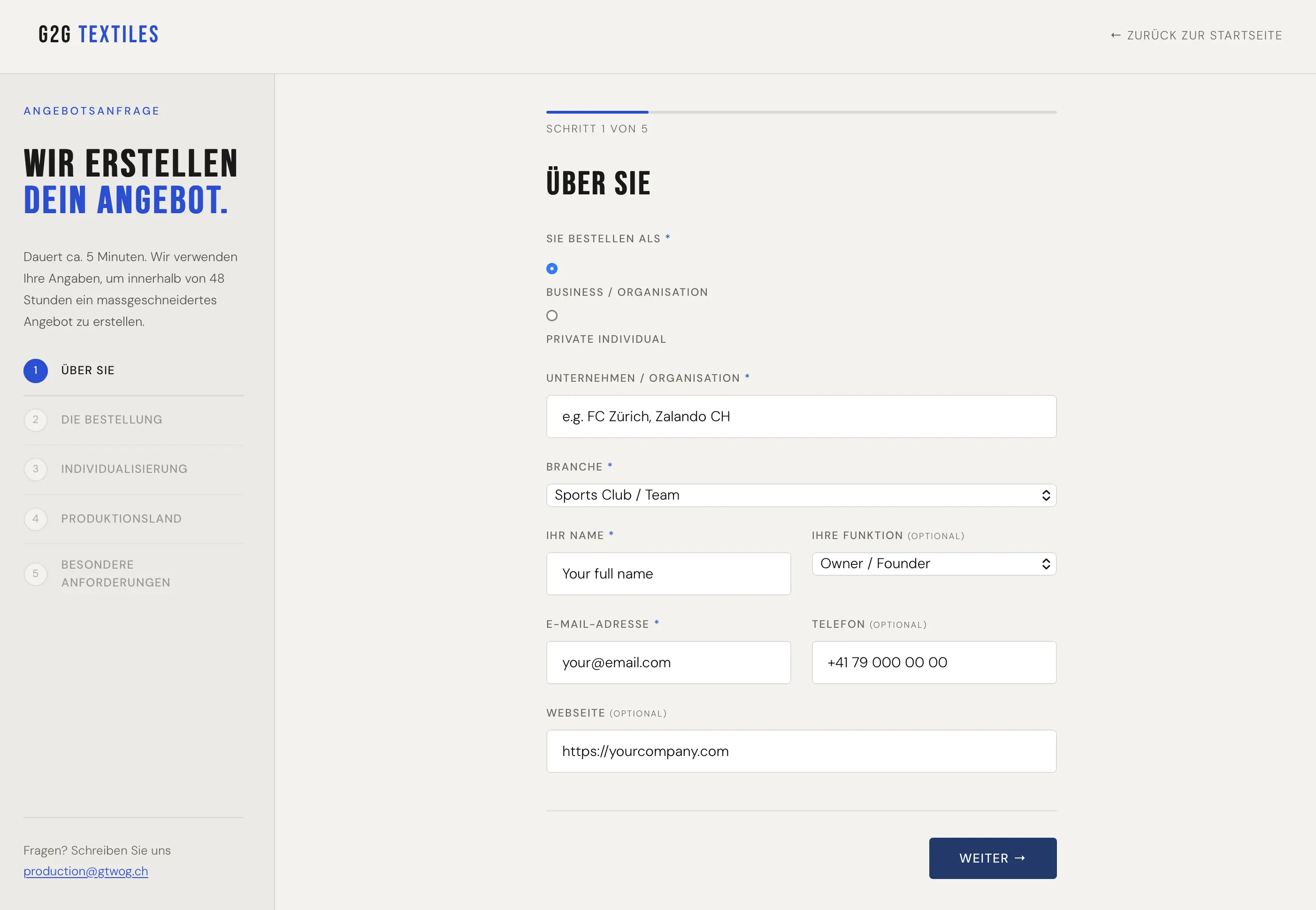
We built our quote process specifically to make this easier. Rather than a blank contact form, our quote wizard walks you through each of these questions in a structured way — product type, quantity, decoration, timeline, budget. It takes around three minutes to complete and gives us everything we need to come back to you with a real quote, not a request for more information.
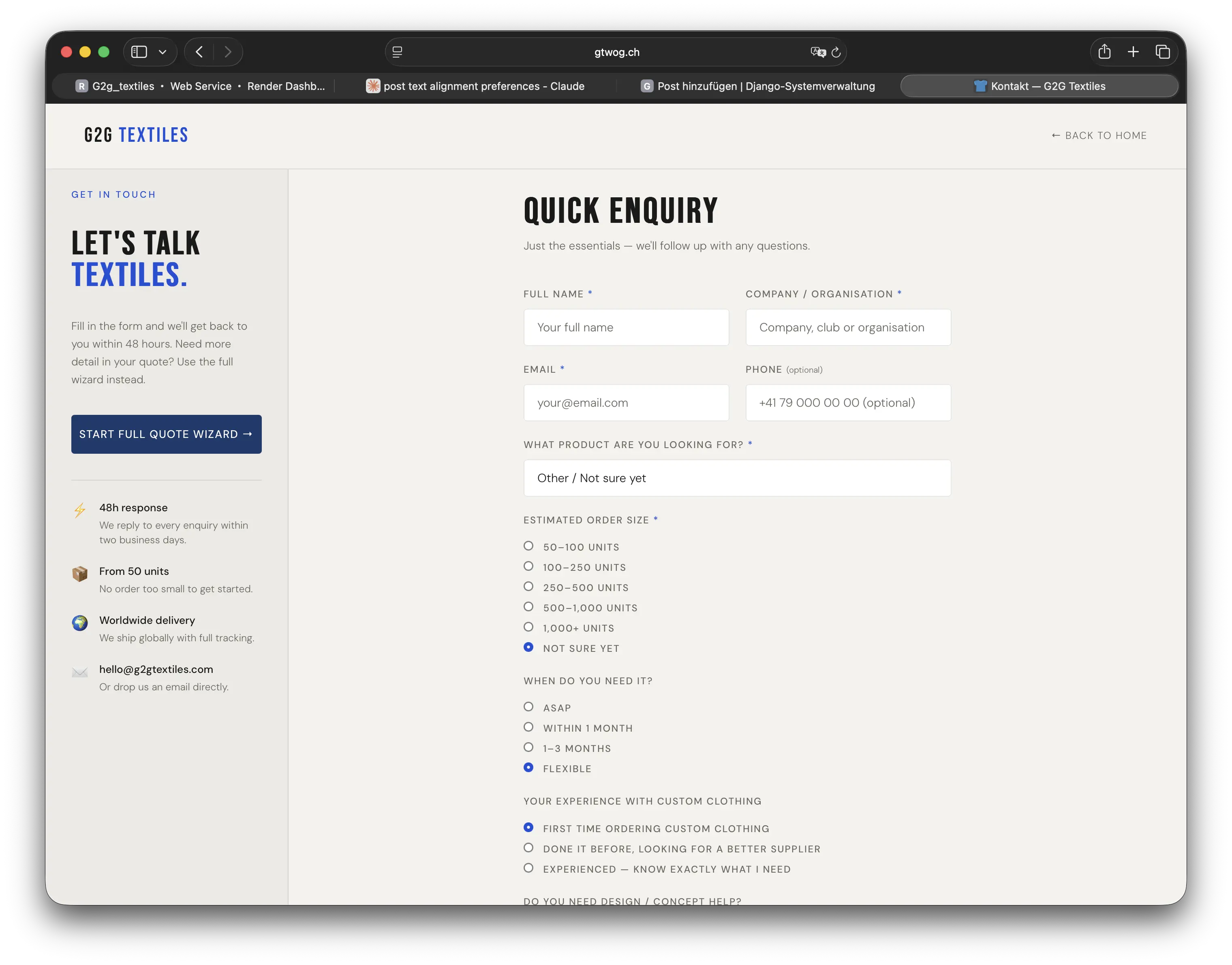
It also helps if you're not entirely sure what you want yet. The questions in the wizard are designed to prompt the right thinking — so even if you're early in the process, working through it tends to clarify your own brief as much as it informs ours.
If you'd like to see what a fully developed product looks like coming out of this process, take a look at our Bloc Magasin case study — a Zurich-based vintage store that developed their first own-brand garment with us. And follow us on Instagram (@g2g_textiles) for behind-the-scenes content, production examples and updates on new projects.
For a real example of how this process plays out for a sports club, take a look at our Minimum Bouldering case study — 90 custom competition kits developed and delivered in 12 weeks.
Ready to get a quote?
Our quote wizard takes about three minutes and gives us everything we need to come back to you with accurate pricing and a realistic timeline.